GuestLeo
· 5 min read
Why n8n is the Ultimate Secret Weapon for Independent European Hotels
Discover how small and medium independent hotels in Europe are using n8n to fix fragmented tech stacks, automate workflows, and beat labor shortages without replacing their PMS.
Why n8n is the Ultimate Secret Weapon for Independent European Hotels
The European hospitality sector is undergoing a quiet but drastic structural shift. Representing over 230,000 to 250,000 properties, the market remains highly fragmented, with up to 75% of establishments operating as independent boutique stays, small inns, or family-owned hotels. Historically, these properties (typically ranging from 10 to 150 rooms) were severely under-automated, relying heavily on spreadsheets and manual operations.
Fast forward to today, and the baseline has changed: approximately 75% of these independent hotels have migrated to cloud-based Property Management Systems (PMS) like Mews or Cloudbeds, and 63% utilize dedicated channel managers. However, a major structural flaw remains. While hotels now have modern software tools, they lack a cohesive ecosystem. Their tech stack is fragmented, data is siloed, and critical operational gaps are still patched up using manual labor, paper checklists, and disjointed WhatsApp threads.
The Operational Reality: The market is no longer looking for “another PMS.” The real multi-billion-euro opportunity lies in building the orchestration and workflow automation layer that ties existing cloud systems together. For small and medium-sized hotels, n8n has emerged as the definitive tool to bridge this gap.
The Pain Points Handled by n8n
Independent hotels are uniquely sensitive to integration friction. When systems do not talk to each other, operations grind to a halt. By introducing n8n as a localized workflow engine, operators can seamlessly tie their cloud PMS APIs to adjacent business tools, tackling five critical operational bottlenecks:
- Front Desk & Identity Automation: Instead of manually scanning IDs or processing payment pre-authorizations during check-in, an n8n workflow can trigger the moment a guest registers. It can fetch passport data from a scanner, route it to local authority compliance portals (mandatory across many EU jurisdictions), pre-authorize credit cards via Stripe, and automatically push digital key codes to the guest’s phone, reducing front-desk administrative labor by 15% to 30%.
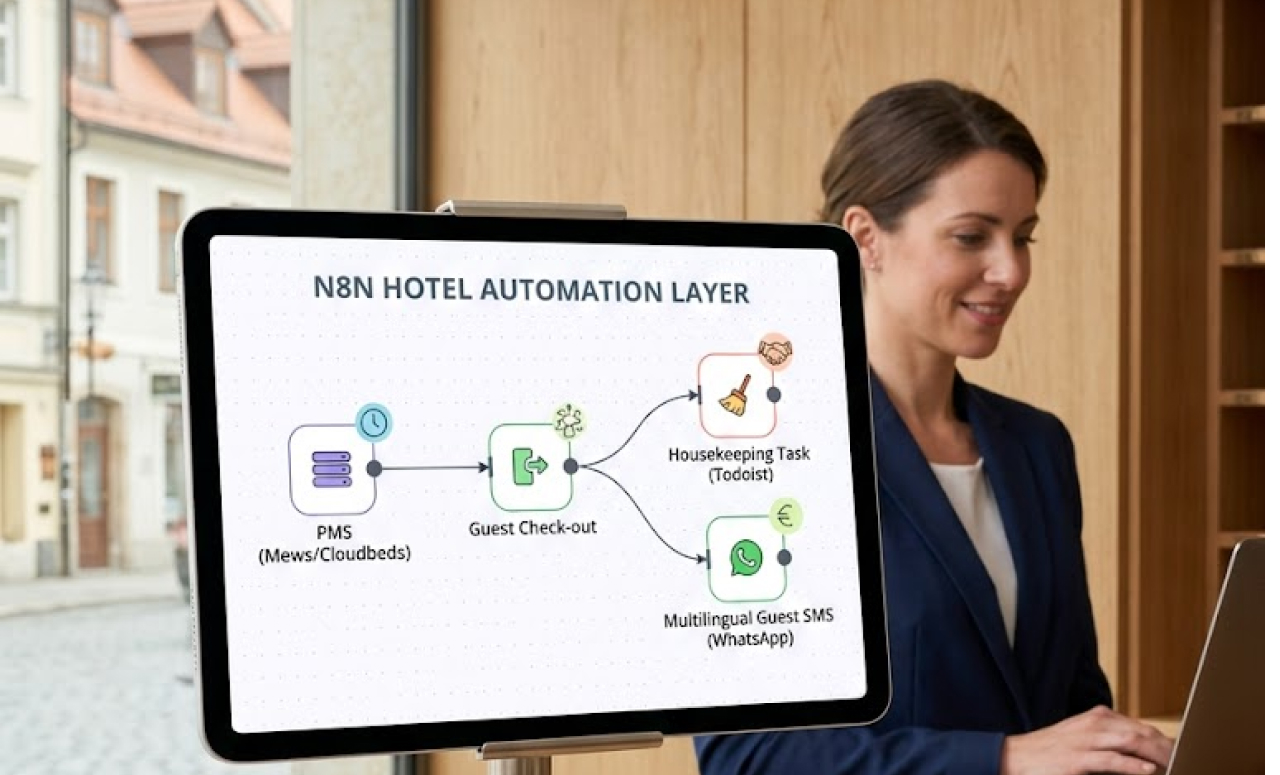
- Housekeeping & Maintenance Ops: Housekeeping is historically managed via paper sheets or fragmented chats. With n8n, a status change in the PMS (e.g., “Guest Checked Out”) instantly creates a cleaning ticket in task managers like Todoist, Trello, or ClickUp, updates the linen cycle forecast, and alerts the cleaning staff via a tailored internal messaging bot. If a minibar item is consumed, n8n can instantly add it as a line item to the guest’s pending invoice.
- Multilingual Guest Communication: Europe is inherently a multi-language market, making automated guest messaging complex. n8n workflow nodes can listen for new bookings, detect the guest’s country of origin, pass the template through an AI translation or LLM node, and schedule hyper-personalized pre-arrival upsell offers, late-arrival guidelines, or post-stay review requests via WhatsApp or SMS.
- Dynamic Back-Office & Localization: The regulatory complexity of VAT, city taxes, and municipal compliance in Europe is notorious. n8n acts as an invisible accounting assistant, fetching daily financial summaries from the PMS, separating accommodation fees from city taxes, generating compliant localized invoices, and feeding clean data arrays straight into accounting tools or payroll platforms.
- Frictionless Revenue Orchestration: While nearly 40% of small hotels lack a robust, dedicated revenue management strategy, an n8n pipeline can continuously feed occupancy percentages and local event data from external APIs into simplified spreadsheet models or AI pricing microservices, pushing updated rates back to the channel manager without manual recalculation.
Why the Time is Now: The Macro Environment
Historically, sophisticated workflow automation was reserved for major enterprise chains with dedicated IT departments. Today, three converging trends make workflow automation a non-negotiable survival strategy for independent European operators:
| Macro Driver | Operational Impact on Independent Hotels |
|---|---|
| Severe Labor Shortages | Post-pandemic staffing shortages have driven labor costs up. Automation is no longer about cutting costs; it is about keeping properties functional with smaller on-site teams. |
| The Cloud Ecosystem Wave | With over 70% of properties now using API-first, cloud-based PMS solutions, the underlying data infrastructure is fully accessible for the first time. |
| Tangible, Practical AI ROI | AI has shifted from a theoretical buzzword to an understandable ROI driver. Hotel owners now expect automation to directly translate to fewer overbookings and automated customer service. |
The Cost-Efficiency Moat: Why n8n Trumps Traditional Alternatives
Small and medium-sized hotels are notoriously price-sensitive, yet they are highly willing to invest when the return on investment (ROI) is transparent. The typical software spend for a small property scales between €200 and €600 per month, while medium-sized hotels spend up to €2,000 monthly on their core stack.
Enterprise integrations are notoriously complex, and relying on native, rigid add-ons often results in “broken syncs” and unexpected licensing fees. This is where n8n provides an unmatched competitive advantage. Whether self-hosted on-premise or managed via a cost-effective cloud instance, n8n allows hotels to build custom, visual automation logic at a fraction of the cost of generic corporate enterprise integration platforms.
By saving even half of a Full-Time Equivalent (FTE) worker’s monthly hours, or by driving an extra 2% to 5% in direct bookings and upsells through automated messaging, n8n pays for itself almost instantly. Instead of fighting uphill battles to replace a hotel’s central PMS, smart operators are using n8n to construct an indestructible, flexible operational layer directly on top of the existing software stack.